AI and Developers: Another Brick or Another Floor?
AI will shake the market — that much is certain. Whether it walls developers in or elevates them depends on a timescale most people forget to consider.I'll be honest with you from the start: I don't know what will happen.
Nobody does.
Anyone who tells you with certainty that AI will eliminate developers — or that developers have nothing to worry about — is selling you something. Probably confidence they don't have.
What I can do is look backwards. And when I do, I see a pattern that keeps repeating, wave after wave, technology after technology.
That pattern is what this article is about.
Two Metaphors, One Conflict
Pink Floyd sang "Another Brick in the Wall" — a song about systems that imprison, dehumanize, flatten people into components of something that doesn't serve them.
When I look at how AI is being deployed today, in a capitalist market driven by short-term results, I see that metaphor playing out in real time:
- Junior developers being replaced before they ever become seniors.
- Hiring freezes justified by "AI can do that now."
- Power concentrating in the hands of whoever controls the models.
- Professionals — real people — absorbing the cost of a transition they didn't choose.
That's the brick.
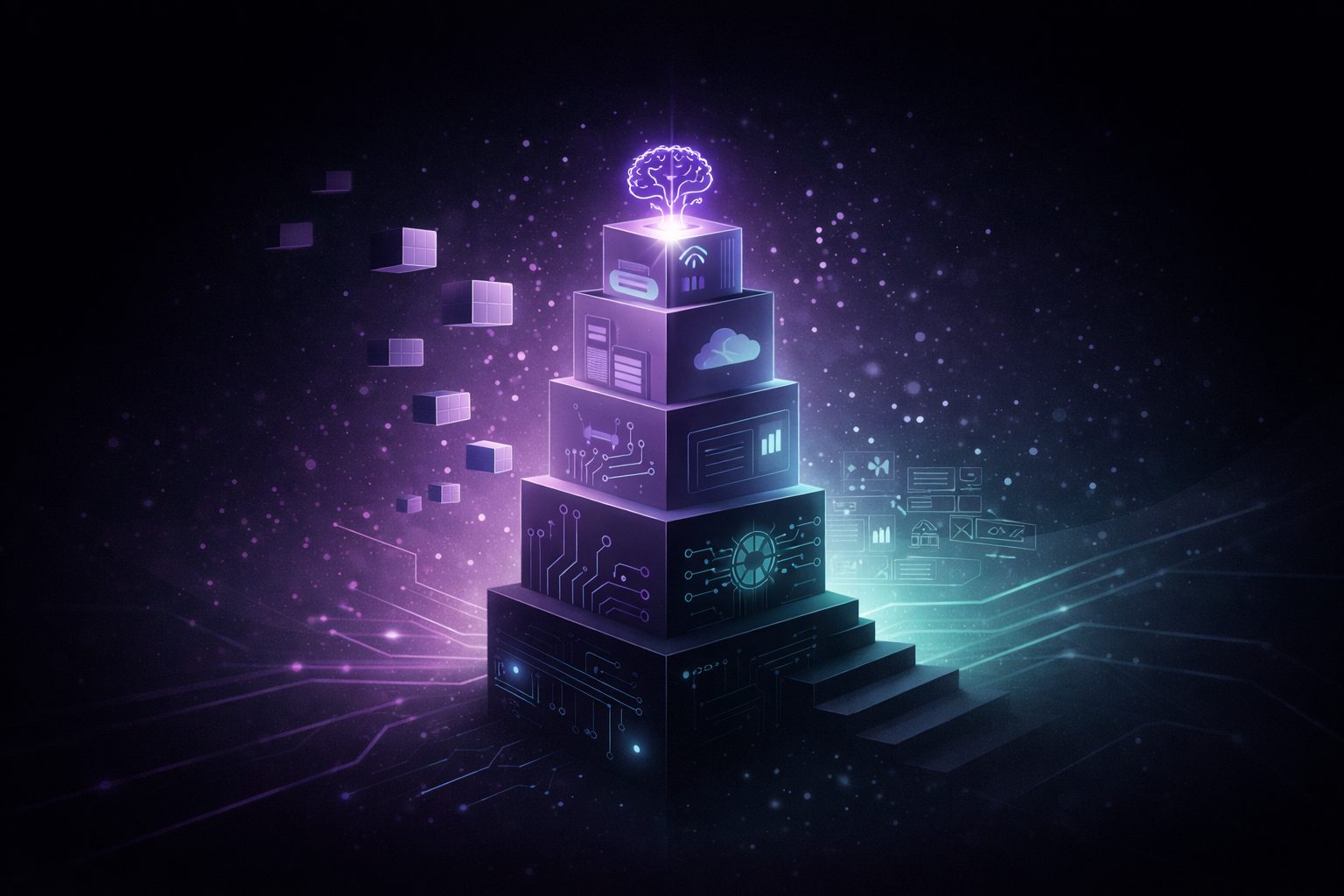
But there's another metaphor. Software engineering is like a skyscraper under construction. Each era adds a new floor of abstraction:
- Machine code. Assembly. Operating systems.
- High-level languages. Frameworks. Cloud platforms.
- And now: AI-assisted development.
Each new floor didn't demolish what was below. It raised the building higher — and made the foundation more critical, not less. The higher the structure, the more pressure on the ground it stands on.
That's the floor.
Both metaphors are true. The conflict between them is the actual question.
The Short Term Is the Brick
Let's not skip past this too quickly.
The disruption is real. It's happening now. It will get worse before it stabilizes.
When a new abstraction layer arrives this fast, the market doesn't smoothly redistribute workers — it shakes the building. People fall. Roles that existed last year disappear before new ones are clearly defined. The people who absorb the cost most aren't the ones at the top making the decisions.
This isn't pessimism. It's pattern recognition.
The cloud computing wave didn't warn sysadmins before it arrived. Mobile didn't send a memo to desktop developers. Each wave produced genuine disruption, real unemployment, real anxiety — concentrated in the people least positioned to adapt quickly.
AI is doing the same thing, and it would be dishonest to pretend otherwise.
The Long Term Is the Floor
But here's what the pattern also shows, consistently, across every technological wave:
The market eventually expands more than it contracts.
High-level languages didn't eliminate systems engineers — they created millions of new developers who never would have learned assembly. Frameworks didn't kill backend developers — they made it economically viable to build software that previously wouldn't have been built at all. The cloud didn't eliminate infrastructure expertise — it created an entirely new discipline, massively scaled it, and produced demand for kernel engineers that hadn't existed before.
We eliminated typists. We employed vastly more people typing.
Each wave lowered the cost of creation. And because creation became cheaper, more things got created. More systems, more complexity, more edge cases, more infrastructure — and therefore, more demand for people who understand what's happening underneath.
AI follows the same trajectory.
It lowers the cost of building software. That means more software will be built. More systems will interact in unexpected ways. More abstractions will leak. More performance limits will be reached. And when they do — someone will need to go downstairs.
Someone always debugs the runtime. Someone investigates the memory behavior. Someone reads the logs nobody else understands.
Higher abstraction doesn't reduce the need for expertise. It creates demand for deeper expertise.
The Real Question Isn't "Will AI Replace Developers?"
That's the wrong question.
The right question is: how long does the brick phase last before the floor phase begins?
Because both are coming. The brick is here now. The floor is being built underneath us whether we acknowledge it or not.
And between those two phases — in the transition, in the turbulence — is where careers are won or lost. Where some people fall off the building and others figure out which floor they're building next.
How to Survive the Wave When It's Your Side That's Threatened
I don't have a formula. But I can share what the pattern suggests.
Don't mistake the wave for the ocean.
The wave is violent and disorienting. It feels like destruction. But waves move through the water — they don't replace it. The underlying dynamics of software complexity, the need for people who understand systems, the value of judgment over mere execution — those don't disappear. They become more scarce, and therefore more valuable.
Understand the floor below you.
Every new abstraction creates distance from the layers underneath. The developers who survive transitions — and who gain leverage in the new world — are the ones who can go downstairs when the abstraction fails. Knowing why something works is more durable than knowing how to operate a tool that might not exist next year.
Position yourself at the boundary.
The most valuable place in any technological transition isn't at the old layer or the new one — it's at the boundary between them. Understanding how AI tools work, where they fail, how they compose with existing systems, what they can't reason about — that's where judgment lives. And judgment doesn't get automated easily.
Acknowledge the cost of transition — in yourself and in others.
If you're in a position of privilege in this wave — senior, established, with runway — use it to help people who aren't. The expansion of the market is not evenly distributed. Mentorship, advocacy, honest writing about what's actually happening: these matter.
The Building Keeps Growing
I can't tell you when the brick phase ends. I can't tell you exactly what the new floor looks like, or what your role will be on it.
What I can tell you is this: every previous wave that felt like the end of software development turned out to be the beginning of a larger one. The building didn't fall — it grew taller. And a taller building needs more engineers, not fewer.
AI is not the end of programming.
It's another floor in a building that has been under construction for decades.
The question isn't whether you'll have a place in it.
The question is which floor you'll choose to build.