Codex Technomanticus (vault + site + Anki)
A public digital garden of 3,312 engineering notes written in Obsidian — with a versioned editor, a theme of my own, an explicit publication gate, a customized Quartz build, and a Python pipeline distilling it into Anki decks.
1. Elevator Pitch
The Codex Technomanticus is my grimoire: a public digital garden of 3,312 software engineering notes, written in Obsidian, versioned in git and published as a site. It is not a blog and not a folder of jottings — it is a knowledge base with a designed information architecture, a typed taxonomy and an explicit publication gate.
Three public repositories work together: the vault, the site that publishes it, and a pipeline that distills the notes into Anki decks.
2. Problem and Context
Every senior engineer carries the same debt: what they know is scattered across memory, bookmarks, chat threads and loose files. The second time a question comes up, the answer is rebuilt from scratch.
I wanted the opposite: a place where the answer is written once, stays linked to its neighbours, outlives me, and can be read by anyone without me in the room. The same discipline I apply to code — versioning, review, contracts, automated publishing — applied to what I know.
The framing is deliberate, and it is mine: software engineering as magic applied to digital reality. Turning intent into a change in reality through precise formulas, verifiable symbols and delivery rituals. The joke is serious — it gave the vault a language of its own, and a language of its own is what makes someone come back.
3. Scope and Role
Sole author of all of it: the content, the environment it is written in, the platform that publishes it, and the pipeline that turns it into study material.
4. Information architecture
The vault is not a pile of files. It has five zones with distinct roles: 00-Meta holds templates, guides, specs, the roadmap and health audits of the vault itself; 01-Pergaminhos and 02-Glosas hold original writing and annotated reading; 03-Dominios is the body of knowledge; 04-Sendas are the study tracks.
Domains, by note count:
| Domain | Notes |
|---|---|
| Technology | 2,082 |
| Engineering | 470 |
| Computer science | 197 |
| Career | 94 |
Inside Technology: Java 381 · AI 365 · Go 208 · Python 202 · Cloud 198 · React 104 · Node 103 · Infrastructure 96 · Terminal 78.
Every note declares what it is. The taxonomy is typed in the frontmatter and drives navigation: concept (2,501), moc — maps of content (319), meta (184), note (81), spec (67), glosa (52), plan (29), reference (24), index (23), report (15).
The publication gate is explicit. 2,390 notes marked publish: true, 700 marked publish: false, and the site publishes only Dominios and Sendas. What is still green stays in the vault until it ripens.
5. The authoring environment
The Codex is written in Obsidian, and the authoring environment is part of the project — not a personal preference living on one machine. The whole .obsidian directory is versioned alongside the notes: appearance, hotkeys, graph configuration, plugins and templates. Cloning the repository hands you the vault and the editor in the same state.
A theme of my own. I wrote the Codex Technomanticus theme — 690 lines of CSS, with a signed manifest — so the editor wears the same skin as the published grimoire and as josenaldo.com.br. Three surfaces, one identity: where I write, where the reader reads, and where I introduce myself. The commit message says it: the same skin as the site.
Fifteen templates in 00-Meta/templates make every kind of note born with the right structure: Note, MOC, Glosa, Glossary, How-To, TIL, Roadmap, Mestre, card, quiz. The type declared in the frontmatter is not a label applied afterwards — it is the shape the note is born in.
Seventeen plugins with a defined job: Templater and QuickAdd for the creation ritual, Dataview to query the taxonomy as if it were a database, obsidian-git to version without leaving the editor, tag-wrangler to keep the taxonomy clean, and a set of Mermaid tools with two CSS snippets of my own so diagrams come out in the Codex theme.
6. The platform that publishes
The site is a Quartz fork with content symlinked to the vault — content is never copied, so no divergent version can exist. On top of that base, what I built:
- A theme aligned with
josenaldo.com.br, so the grimoire and the site read as the same house. - An explorer ordered and numbered by filename, with working folders hidden.
- Breadcrumbs, reader mode, custom callouts, a Mermaid theme and code highlighting.
- Accent-free lowercase slugs, plus accessibility and narrow-screen layout fixes.
- Automated visual acceptance checks in
verify/, running in CI alongside five GitHub Actions workflows: integration, preview build, preview deploy, deploy, and Docker image publishing.
A push to the vault triggers the site deploy. Writing and publishing are the same gesture.
7. The distillation
The third repository is a Python pipeline — genanki, pyyaml, markdown, packaged with uv and exposed as a CLI — that reads cards written in Markdown and generates an Anki deck with sub-decks by domain: Fundamentals, Architecture, Java, JavaScript, Infrastructure. It has card validation, tests, and a workflow that publishes the .apkg as a release.
The note is the source; the flashcard is derived. No content is typed twice.
8. Agent workflow
The vault versions 31 agent skills in .agents/skills — among them escrever-nota, enriquecer-nota, enriquecer-galho, diagnosticar-galho, glosa, glosa-video, colher-duvidas, plantar-duvidas, deadlink, json-canvas, obsidian-markdown.
That is what makes 3,312 notes possible without turning into a dump: the agent performs the ritual, and the ritual is written down, versioned and reviewable. Architecture, curation and final review stay mine.
9. Seeding and tending
The garden has two modes, and they explain the shape of its history. When a new subject catches me, I seed the whole domain — heavy, concentrated work that shows up as a spike. Then comes tending: enriching, linking, correcting, pruning. The vault's first version was almost all seeding; today the work is mostly tending, and new seeding happens only when a new subject arrives.
It is not a project that finishes. It is a garden.
10. Portfolio Relevance and Links
This project demonstrates what I argue for in engineering, applied outside client code:
- Documentation as a first-class artifact, with contracts and review
- Information architecture and taxonomy designed, not improvised
- Automated publishing, with an explicit gate between draft and public
- An AI agent workflow where the ritual is versioned and the review is human
- Content as a single source, with derivatives generated — never duplicated
Links:
- Site: https://josenaldo.com.br/codex-technomanticus-site/
- Vault: https://github.com/josenaldo/codex-technomanticus
- Platform: https://github.com/josenaldo/codex-technomanticus-site
- Anki decks: https://github.com/josenaldo/codex-technomanticus-arcana
11. Visual Evidence
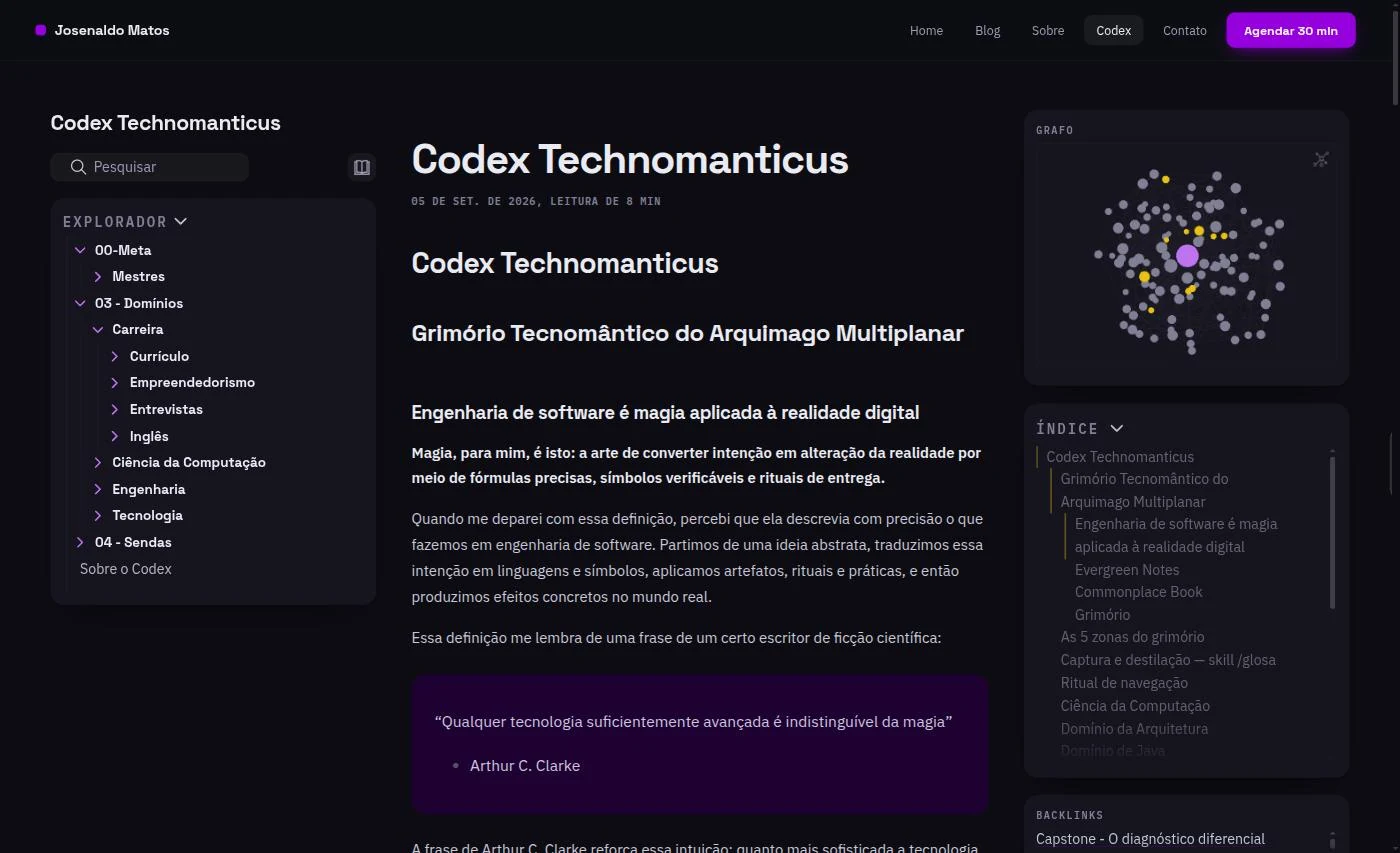
The published grimoire: explorer on the left, link graph and table of contents on the right, theme aligned with josenaldo.com.br.
Keep exploring
Workaround-Oriented Programming (Book)
BookA full editorial platform for a living technical book — built with Next.js, Contentlayer, and a Git-based publishing pipeline to write, version, and ship content continuously.
Farofa Lampiao e Julieta
RecipeA signature recipe turned into a memorable portfolio artifact: a repeatable culinary product with intentional humor and strong personal branding.